As part of the MONA project, the Saarland Tourism Board has developed a campaign based on a cultural reference: Tatort. For those unfamiliar with the series, Tatort translates as 'crime scene' and is a German-language crime series that has been running continuously since 1970. This makes it the longest-running German TV drama and it is not confined to Germany, but also includes Austria and Switzerland. Each episode is set in a different city or region with a different police team, and the local landscape, architecture, dialect and customs play as much of a role in the story as the detectives themselves. On Sunday evenings, millions of viewers across Germany, Austria, and Switzerland tune in.
The Saarland is one of the regions that produces its own Tatort episodes. The Tourismuszentrale Saarland drew on this cultural connection to develop a campaign called Tatort Natur (Nature Crime Scene). Rather than starting with rules and prohibitions, the campaign uses the familiar codes of the crime series to reframe everyday behaviours in nature as small criminal cases.
Playfully borrowing the language and structure of Tatort, the campaign draws attention to three specific behaviours that harm the natural environment:
The first case concerns leaving marked trails. Nature reserves are refuges for animals and plants, and many protected areas have designated paths for visitors. When people leave these paths, sensitive ground becomes disturbed, plants are damaged, and habitats are altered. Wildlife responds to the presence of humans by fleeing or interrupting its feeding activities. Repeatedly taking shortcuts gradually creates informal trails that are mistaken for official routes, thereby spreading the impact across wider areas. Dogs off the path cause further disturbance. Therefore, staying on marked paths is not an unnecessary restriction, but one of the simplest ways to protect the natural environment.
The second issue is litter. Waste left in a nature reserve breaks down slowly and causes lasting damage to the soil, water and wildlife. It takes ten years for a cigarette butt to break down in nature, and five hundred years for a drinks can. Even seemingly harmless items such as banana skins do not belong in a nature reserve as they are not part of the natural habitat and may carry pesticide residues that affect soil organisms. The campaign's principle is simple: whatever you bring into a nature reserve, you must take it back out with you.
The third case covers interference with protected habitats. This goes beyond visible actions such as littering or entering restricted areas. Noise, drones, loud music and other leisure activities can disturb wildlife and alter its behaviour in ways that are less visible but equally damaging. Noise can affect communication between animals, the location of prey, mating, and the rearing of young, and it is particularly harmful during breeding, wintering, and migration periods. Drones present a particular problem as their sudden appearance and low-altitude flights can startle sensitive species. Nature reserves are protected precisely because they are valuable habitats for specific species: as human activities increasingly encroach upon these refuges, their protective purpose is undermined.
The campaign poses the same question in response to each of these three cases: what traces do you want to leave behind? The answer is simple: none.
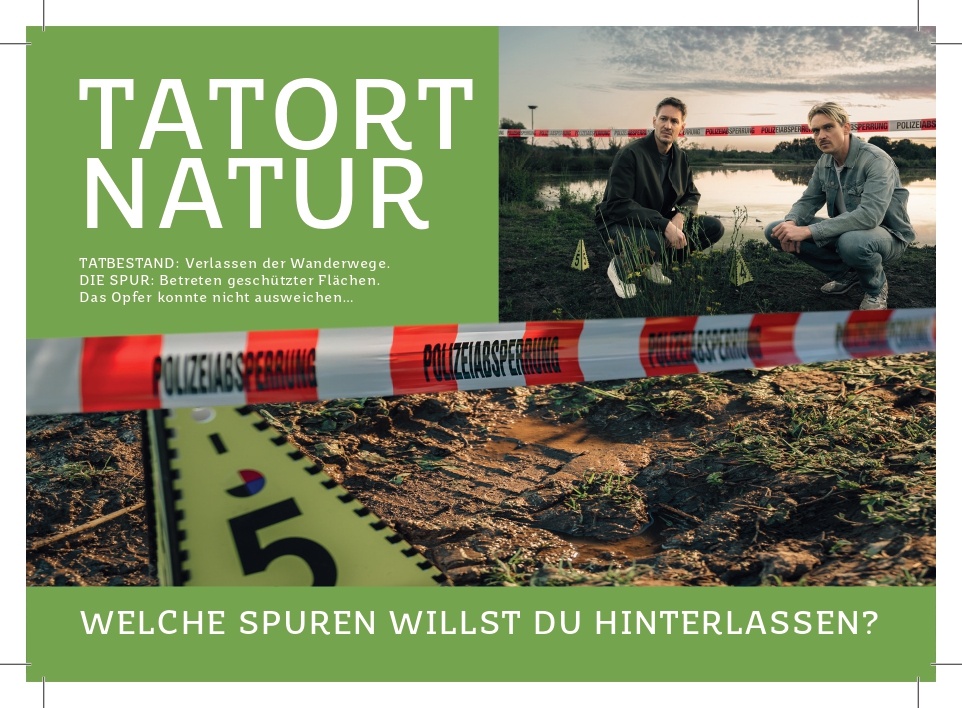
(What traces do you want to leave behind?) © Dreihundertzehn Werbeagentur
The video is available in German at: https://www.youtube.com/watch?v=-VNroJ0kpG0